| Bhutan
- The Land of Weaving and Textiles |
| Bhutan's
Textile Industry |
 |
Bhutan's
Economy |
|
|
Bhutan Information |
|
|
 |
|
Welcome
to the land of weaving and textiles. |
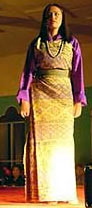 |
Centuries
old, vibrant, ongoing, ever changing and popular - textiles are Bhutan's
new national emblem. The weaving and textile emblem has today come to symbolize
Bhutan in the eyes of the world. People see Bhutan's history, religion,
culture, and indeed its entire way of life woven into the warp and weft
of its rich, diverse and distinct fabrics. Western textile lovers and experts
are even lyrical about the country's textile heritage and weaving tradition.
For some, it is "a craft with no equal" in the world. Others think it is
"one of the last great Asian textile art traditions".
Francoise
Pommaret, a French anthropologist who is a Bhutan specialist, says in a
paper on Bhutanese textiles that there might not be any country in the
world "where weaving has so much relevance to the understanding of a society".
|
She adds that far from being "a thing of the past", fabrics in Bhutan today
have multiple functions. "These functions give to a traditional craft an
astonishing dynamism which is lost in most of the countries where ethnic
fabrics are manufactured for the tourist trade and have no or little relevance
in their own society."
According
to Francoise Pommaret, the market for traditional fabrics is created by
a combination of mainly three factors: the development of the tourism
industry; the emergence of an urbanized bourgeoisie linked to the development
of the civil administration and private business; and the government policy
promoting Bhutanese cultural identity.
Long
ago, as with all early societies, the Bhutanese wove to clad themselves.
Much later, in an age of barter, textiles served as a currency. The Bhutanese
bought commodities from neighbouring countries using textiles. Bhutan even
presented textiles and fabrics as gifts to friendly countries, especially
its northern neighbour, Tibet.
Until
the 1950s, before the monetised economy, fabrics were paid as tax to the
state. A paper by American curator Diana K. Myers, notes that half a dozen
kinds of fabrics were used as tax payments. Some were redistributed as
state payments to officers and common labourers. Fabrics were also offered
to officials in return for favours. Today, panels of cloth are essential
gifts at weddings, promotions and other social and official occasions.
| Textiles:
Symbol of wealth and social status |
Textiles
are not only symbols of wealth, but also of social status. The Bhutanese
place a high premium on textiles. So much so that people's worth are often
assessed based on the clothes they wear. Today there are sesho (silk) ghos
and kiras that sell upwards of Nu. 50,000. A young civil servant says:
"It is not the gho or kira, but the associations and attributions to it
that matter." With philosophies like this, little wonder then that Kezang
Lhundrup (one of Bhutan's few men weavers) presently designing a sesho
gho, thinks it will easily fetch Nu. 80,000. In the old days, textiles
with intricate and elaborate designs were woven for and used or worn only
by noble families. The nobility measured their wealth and status based
on their textile possessions. They competed with each other to come up
with the best designs and patterns and the finest weaves. These were kept
as family heirlooms. The trend continues to this day.
| Textiles:
Investment and assets |
Textiles
are also looked upon as an investment and treated as disposable assets,
like gold or land for instance. Westerners often point out that Bhutanese
trade fabrics and dresses like people elsewhere trade stocks. From purely
its primary utilitarian purposes in the beginning and domestic and ceremonial
uses later, textiles today have become an income-generating industry.
| Textiles:
Tourist souvenir |
Textile
products serve as souvenir items for tourists. Handicraft stores and showrooms
have mushroomed all over the country. With the initiation of planned modern
development and monetization of the Bhutanese society, new utility and
demands for textiles are emerging. The Bhutanese are becoming an increasingly
fashion mindful and conscious lot. They want larger, better and more chic
wardrobes. The use of traditional fabrics is becoming diversified.
|















