| Bhutan
- The Land of Weaving and Textiles |
| Bhutan's
Textile Industry |
 |
Bhutan's
Economy |
|
|
Bhutan Information |
|
|
 |
|
The
origin of textiles is rather vague |
Books,
studies and academic papers on Bhutanese textiles by researchers and experts
only point to the "links" that Bhutan shares with weaving traditions in
the nearby regions and other places further away such as Tibet and Southeast
Asia. The origin is not mentioned anywhere in Bhutan's recorded history
either.
| Art
of weaving since 13th century |
A
paper compiled by the textile museum says that the art of weaving existed
since the 13th century.
| The
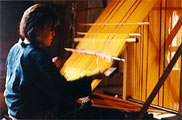
back-strap loom, according to the paper, is mentioned in the biography
of Phajo Drugom Shigpo (1208-76) and the first depiction of clothing can
still be seen in the wall paintings at the Changangkha lhakhang dating
back to 1270. According to Rinzin Pemalingpa's biography (1450), "his mother
wove and gifted him a bolt of woolen fabric". The paper assumes that other
yarns were in use at that period. Bhutan was self sufficient in weaving
in the past. |
 |
The
earliest known textiles were woven out of fabrics obtained from zocha,
a nettle grass. It was widely used for clothing and other purposes. Coarse
cotton cloth was woven from cotton grown in warmer regions. Bura was woven
from wild silk produced by giant silkworm moths. Bhutan has also had a
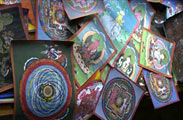
long history of using vegetable dyes. Indigenous dyeing methods were employed
to dye homespun fibers into basic colors. Dyeing techniques were passed
from mother to daughter, from generation to generation.
 |
Families
would have their own secret recipes and master dyers received just as wide
a reputation for their skills as weavers.
Textile
Arts of Bhutan, considered the definitive collection of writing on Bhutanese
textiles by Michael Aries, Francoise Pommerat, Diana K. Myers and Susan
S. Bean, says textiles and dress features shared by Bhutanese and immediately
adjacent communities arose from common cultural histories. |
|
"Textile and
design influences also transcended borders through economic, political,
and religious contacts between the Bhutanese and their more far-flung neighbours
in present-day northeast India," the book notes adding that forms and practices
relating to ritual and ceremonial textiles came from Tibet.
"Together,
these influences helped create Bhutan's extraordinary, rich, and sophisticated
textile heritage." The book says that the textile designs of northeast
India "display a striking resemblance" to those in Bhutan. Backstrap looms
were at one time widespread and are today found in Sikkim, Arunachal Pradesh,
Assam, Nagaland, and Manipur in northeast India.
| There
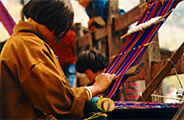
are several myths surrounding the origin of the backstrap loom, locally
know as pangtha. The most popular belief is that the loom, and perhaps
weaving along with it, was introduced in Bhutan by the Chinese wife of
Tibetan king Songtsen Gambo, Ashi Jaza. There are presently three types
of looms being used in Bhutan - pangtha, thritha, and soghu thagshing.
The thritha, according to some accounts, was introduced in Bhutan by the
Thimphu zimpon Rinchen Dorji from Tibet. |
 |
It
is generally accepted that Zhabdrung Ngawang Namgyel introduced the gho
around the first half of the seventeenth century. It was adapted from the
Tibetan chuba to suit Bhutan's warmer climate and to provide unrestricted
movement on the mountainous terrain. The kira bears no resemblance to any
Tibetan costume. There are no records of the women's attire. However, the
gutsuma, a tunic made out of two panels of the kushu fabric, is believed
to be worn by women much before the kira. This dress has almost disappeared
except for a small group of women in Kurtoe who wear it today to honour
local deities.
Textile
Arts of Bhutan says that textiles flourished and became popular in Bhutan
because the ruling Wangchuck dynasty came from a renowned weaving region,
Kurtoe. "In the mid-nineteenth century, as the Wangchucks gained influence
and moved westward from north central Bhutan, the prestige and influence
of weaving techniques and decorative styles from the royal family's home
region spread throughout the country."
The book refers to the period from
the mid-19th century to the mid-20th century as the "golden age" of Bhutanese
weaving. Most fibres were produced, dyed, and woven locally in the early
part of this period. The finest specimens of textiles called "hingthams"
or heart weavings were made during this period. Despite the limited range
of dyes and fibres back then, the wide distribution of skills and thorough
knowledge of local materials ensured a supply of "superbly crafted textiles".
Although weaving has spread to all parts of the country today, it was traditionally
the domain of eastern Bhutan. A theory posited by some independent researchers
is that weaving developed in the east because of the rugged physical terrain
and limited cultivable land. Western Bhutan is plainer and there is a lot
of cultivable land. People had big farms and did not have time to weave.
|













